
News
Seminar on “Economic Position Index (EPI): Quarterly Macroeconomic State of Dhaka”
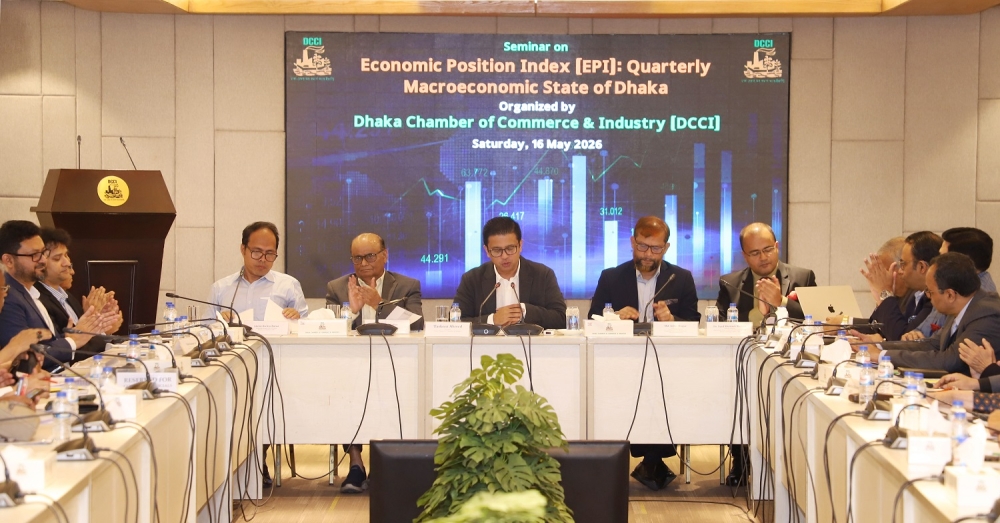
A seminar titled “Economic Position Index (EPI): Quarterly Macroeconomic State of Dhaka” organized by the Dhaka Chamber of Commerce & Industry (DCCI) was held on May 16, 2026 at the DCCI Auditorium.
In his welcome remarks, DCCI President Taskeen Ahmed stated that Bangladesh’s economy is currently going through a challenging period marked by high inflation, pressure on foreign exchange reserves, sluggish investment, energy uncertainty, rising manufacturing costs and declining employment opportunities, all of which are creating pressure on the macroeconomy. He mentioned that the country’s conventional macroeconomic indicators and measurement systems are failing to accurately reflect the real-time economic condition and short-term changes, thereby limiting effective policy responses. In this context, the “Economic Position Index (EPI)” developed by DCCI is a timely initiative that will help policymakers, entrepreneurs, and researchers take effective decisions based on actual economic conditions.
The keynote paper was presented by DCCI Secretary General (Acting) Dr. A.K.M. Asaduzzaman Patwari. He stated that Dhaka Chamber has undertaken the initiative to develop the “Economic Position Index (EPI)” on a quarterly basis to address the lack of adequate information regarding business, trade, investment planning and economic forecasting. Considering the concentration of industrial activities, the research was conducted in Dhaka using data collected during the first quarter (July-September) and second quarter (October-December) of FY2025-26. He mentioned that the data for this index was collected from 762 respondents, including 330 representatives from the manufacturing sector and 432 from the service sector. He further noted that analysis of the survey findings revealed that climate change is adversely affecting the agricultural sector, particularly food production; energy shortages have caused stagnation in industrial production; and declining purchasing power is hindering the growth of the service sector. To overcome the current challenges, he emphasized the need for market price stabilization and supply chain improvements to protect farmers’ interests, easy and low-interest loans for CMSME entrepreneurs, uninterrupted energy supply for industries, infrastructure development, reduction of time and harassment in obtaining trade-related licenses, lowering existing VAT rates and accelerating cargo inspection and clearance procedures at ports.
The designated discussants at the seminar included noted Economist and Chairman of Policy Research Institute of Bangladesh (PRI) Dr. Zaidi Sattar; Professor of Accountancy & Public Policy, Department of Accounting, Faculty of Business Studies, University of Dhaka Dr. Mizanur Rahman; Professor of Economics, University of Dhaka Dr. M Niaz Asadullah; Additional Secretary (IIT), IIT Wing, Ministry of Commerce, GoB Shibir Bicitro Barua; International Trade Expert (Former Additional Secretary), Support to Sustainable Graduation Project (SSGP) Nesar Ahmed; Joint Secretary and Former Director General, Bangladesh Investment Development Authority (BIDA), GoB Md. Ariful Hoque; Director General, International Trade, Investment & Technology Wing, Ministry of Foreign Affairs, GoB Dr. Syed Muntasir Mamun; and Senior Private Sector Specialist, International Finance Corporation (IFC), World Bank Group Miah Rahmat Ali.
Dr. Zaidi Sattar, Chairman of the Policy Research Institute of Bangladesh (PRI) stated that although the research was conducted focusing on Dhaka, its acceptability and effectiveness would increase significantly if it can be expanded nationwide. He added that such an index would help entrepreneurs to assess the current business climate and take appropriate measures accordingly.
Nesar Ahmed, International Trade Expert (Former Additional Secretary), Support to Sustainable Graduation Project (SSGP) said that Bangladesh exports the highest volume of goods to the European market under duty-free facilities. However, following the country’s graduation from the LDC category, Bangladesh may lose these benefits. In addition, the CMSME sector is at risk of being severely affected. He stressed that there is no alternative to reducing the cost of doing business and ensuring supportive business policies to overcome the current situation.
Shibir Bicitro Barua, Additional Secretary (IIT), IIT Wing, Ministry of Commerce, GoB mentioned that the country’s major economic challenges at present are high inflation, negative investment trends and fragility in the banking and financial sectors. He said Bangladesh’s economy is currently going through a difficult phase and to better understand the actual state of the economy this type research should be conducted nationwide. He also informed that the Ministry of Commerce has undertaken necessary reforms to the “Import Policy Order,” which is expected to be finalized within the next few months.
Dr. Mizanur Rahman, Professor, Accountancy & Public Policy, Department of Accounting, Faculty of Business Studies, University of Dhaka observed that in recent years, expenditures in both the public and private sectors have exceeded income levels, while sluggish investment growth has slowed overall economic activities. To overcome the situation, he emphasized the necessity of institutional reforms, especially strengthening the capacity of financial sector institutions.
Dr. Syed Muntasir Mamun, Director General, International Trade, Investment & Technology Wing, Ministry of Foreign Affairs, GoB stated that Bangladesh should depend more on capital market for long-term financing instead of relying heavily on the banking sector. He remarked that the country’s capital market remains weak and that there is also a lack of mental preparedness to increase reliance on it.
Md. Ariful Hoque, Joint Secretary, Former Director General, Bangladesh Investment Development Authority (BIDA), GoB mentioned that sector-specific information plays an effective role in policymaking, institutional reform and providing incentives. He added that although Bangladesh has favorable business-supportive policies, implementation still not up to the mark. However, if the scope of getting public services could be more digitalized, the hassle faced the private sector would be reduced significantly.
Professor Dr. Akhand Mohammad Akhtar Hossain, Chief Economist, Bangladesh Bank stated that there is no alternative to Foreign Direct Investment (FDI) for increasing economic growth, an area in which Bangladesh is still lagging behind.
Professor Dr. Akhand Mohammad Akhtar Hossain, Chief Economist, Bangladesh Bank stated that there is no alternative to Foreign Direct Investment (FDI) for increasing economic growth, an area in which Bangladesh is still lagging behind.
Miah Rahmat Ali, Senior Private Sector Specialist, International Finance Corporation (IFC), World Bank Group emphasized that the government must come forward with necessary policy and financial support for entrepreneurs to tackle global economic instability caused by wars and climate change.
During the open floor discussion session, former Senior Vice President of DCCI Alhaj Abdus Salam, former Director M. Bashirullah Bhuiyan among others also spoke.
DCCI Senior Vice President Razeev H Chowdhury, Vice President Md. Salem Sulaiman, members of the Board of Directors and representatives from both public and private sector were also present on the occasion.
Published on: 2026-05-16